Air cargo is full of empty space. That's a packaging problem.
Air cargo is sold by weight and volume. If your carton is mostly air, you will pay for the air. That's a packaging problem people keep filing under freight.
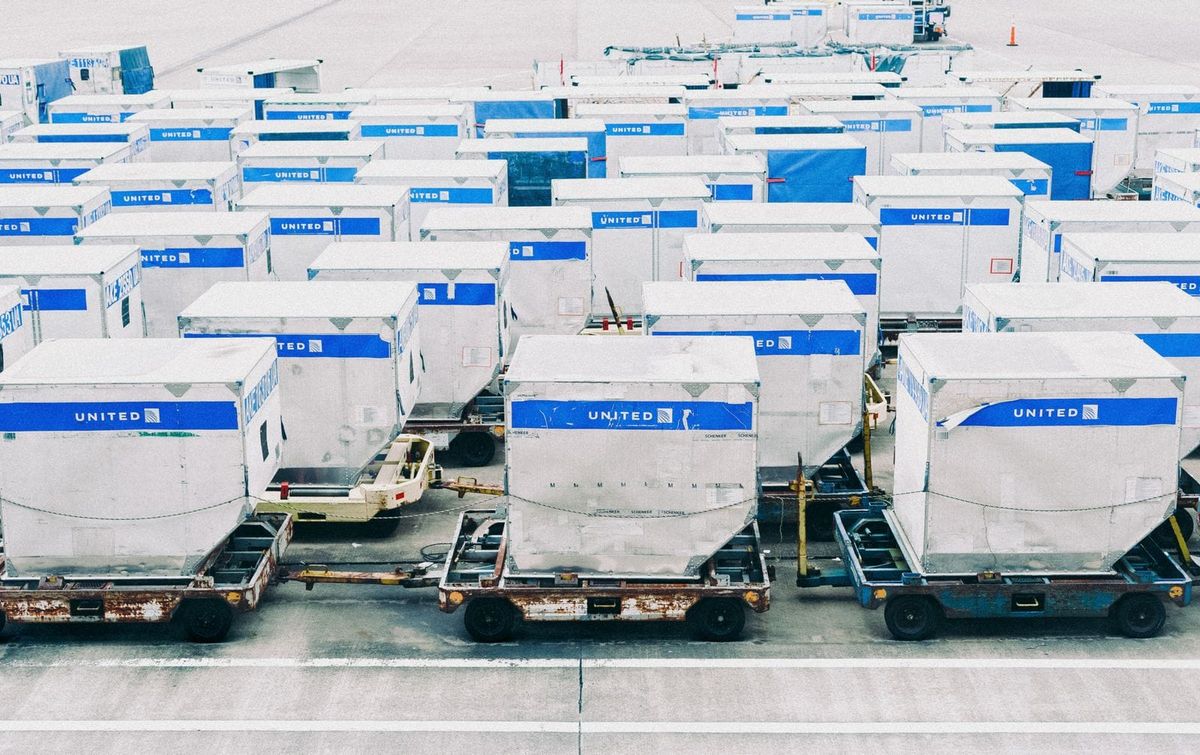
Open a carton that was booked on air and you'll see the real product. Air. A lot of it. Product in the middle, cardboard doing a job a smaller box could have done, void fill performing confidence. Then the invoice arrives and everyone acts like fuel prices did this.
Fuel did some of it. Airlines did some of it. The carton did the rest. Air cargo is sold by a combination of weight and volume. If your parcel is a balloon with a SKU in it, you will pay for the balloon. That's not a mystery. It's a packaging problem that people keep filing under freight.
You are not unlucky on air. You are paying for empty space you designed.
The wrong villain again
The wrong question is why air got expensive. Air was always expensive. That's the point of it. The useful question is what cubic metres you bought that did not contain product. Dimensional weight is not a trick the airline plays. It's the airline refusing to fly your packaging philosophy for free.
I've watched brands spend months negotiating a rate and twenty minutes on the carton. The rate looks like procurement. The carton looks like warehouse. They sit in different meetings. The P&L does not care which meeting they sat in. The P&L sees a cost per kilo that is really a cost per box of air.
On cross-border, this gets worse, because the carton also has to survive a handoff chain it was never designed for. Airline. Ground handler. Broker. Station. Bike. A box that made sense on a pallet in an origin warehouse can be a joke on a last-mile route, and still have been billed like a small fridge on the flight over.
What empty space actually is
It's a process gap. Someone chose a mailer, or didn't. Someone had a minimum carton size because the packing bench was set up for something else. Someone was scared of damage and solved fear with volume. Someone never looked at the chargeable weight on a sample shipment before they scaled the SKU.
None of that is exotic. It's also none of it "freight strategy." It's packaging as an operating system. If you don't have a rule for how a SKU is allowed to occupy space, you don't have a rule. You have a packing bench making commercial decisions in real time, which is a very expensive way to design a product.
People like to talk about sustainability here. Fine. Flying empty space is stupid for carbon as well. I'm not going to pretend that's why operators fix it. They fix it because the invoice is loud. If the invoice isn't loud yet, wait until volume shows up. Empty space scales beautifully.
What you do instead
You measure chargeable weight against actual product. You look at a SKU and you ask what box it deserves, not what box you have. You test a lane with the real pack, not the lab pack. You stop letting "protective packaging" be an unbudgeted religion. Protection is a spec. Specs can be written. Religions get invoiced.
You also stop treating the 3PL as the designer of your carton. A 3PL will pack what you send, in the materials you approved, at the bench they have. If you wanted engineering, that was a brief. If you didn't brief it, you'll get the default, and the default is usually bigger than it needs to be because damage claims are visible and cubic metres are not, until they are.
This is the same pattern as everything else I write about. You outsourced the thinking. You kept the invoice. Then you argued with the invoice.
A rate card cannot save a carton that is mostly nothing.
Cross-border makes the air louder
In one market, a fat carton is a last-mile inconvenience. Across six markets, on air, it's a commercial event. You're paying international rates to move a design decision from a packing bench. Indonesia will not forgive that carton. Vietnam will not forgive it. The bike in Manila will not forgive it. The airline already billed you for it before any of them saw it.
I sit in special projects on cross-border. I see lanes get discussed as if the physics of the box were a later chapter. It isn't a later chapter. It's the first cost you can actually touch without a new contract. You can renegotiate air for months. You can change a carton this week.
I'm not going to publish a savings number I don't have. I'm not going to pretend every SKU can go into a flatter pack. Some products are awkward. Some really do break. That's a spec, again. The thing I will say is this: if your air bill hurts, open the box before you open a negotiation. Look at the empty space. That's the product. That's the problem. Treat it like an operation, not like weather.
Weather you endure. Packaging you design. Most of what people call an air cargo problem is the second thing wearing the first thing's clothes.